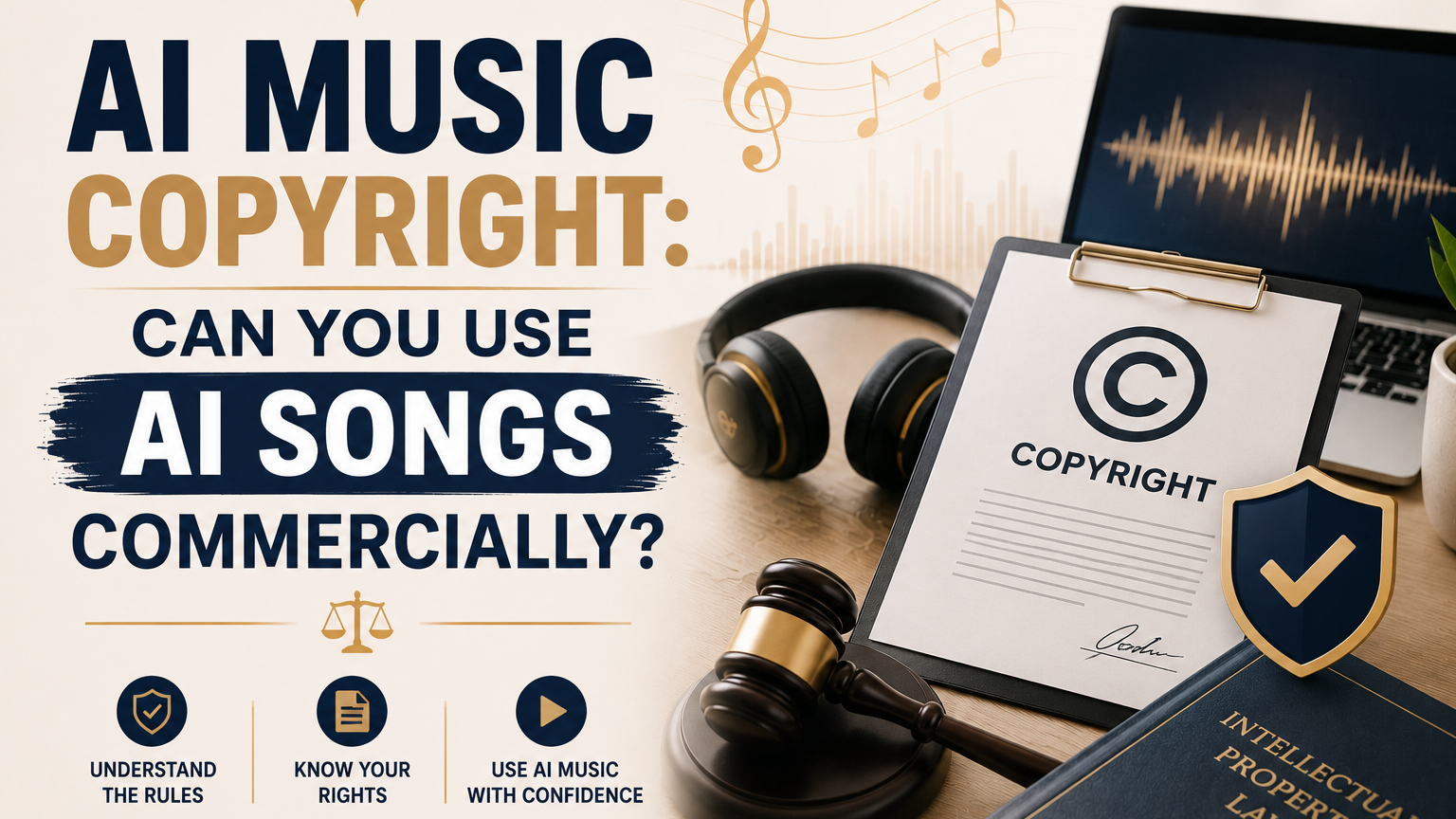
Yes, you can sell AI-generated music commercially in 2026. Most AI music platforms grant commercial rights on their paid plans, and no law in the US prohibits selling AI-made tracks.
But here's the catch that trips people up: having the right to sell something is not the same as owning the copyright to it. That distinction matters more than most creators realize.
Let's break down exactly what you can and can't do with AI music right now, what recent court rulings mean for your tracks, and how to protect yourself legally.
Disclaimer: This article is for informational purposes only and does not constitute legal advice. Copyright law around AI is evolving rapidly. Consult a qualified attorney for guidance on your specific situation.
Commercial Rights vs. Copyright: Why the Difference Matters
This is the single most important concept in AI music copyright, and most articles gloss over it. So let's get it straight.
Commercial rights mean the platform you used — Suno, Soundraw, MusicWave.ai, or any other tool — gives you permission to sell, stream, or license the music you generate.
They won't come after you for making money with it. That's a contract between you and the platform.
Copyright is different. Copyright means you legally own the creative work and can prevent others from copying, distributing, or profiting from it without your permission. It's enforceable in court.
Here's why that matters in practice: if you release an AI-generated track on Spotify and someone else copies it note-for-note, your ability to take legal action depends on whether you hold a valid copyright — not just whether your platform said you could sell it.
Think of it this way: commercial rights let you play offense (go to market). Copyright lets you play defense (protect what you made).
What US Copyright Law Actually Says in 2026
The legal landscape has shifted significantly over the past 18 months. Two major developments define where things stand today.
The January 2025 Copyright Office Ruling
In January 2025, the US Copyright Office clarified its position on AI-generated works. The key takeaway: AI-generated content can be registered for copyright, but only when it reflects "meaningful human authorship."
What does that mean? Copyright Examiners evaluate each application on a case-by-case basis, looking at the degree and nature of human creative control over the final work.
Typing a prompt into an AI tool and clicking "generate" doesn't qualify. But if you write lyrics, arrange the composition, edit the output, and make substantive creative decisions throughout the process, you're in much stronger territory.
The Copyright Office didn't draw a bright line. Instead, they established a spectrum — and where your work falls on that spectrum determines whether it's eligible for registration.
The April 2026 Federal Court Ruling
Then came the landmark that everyone in the AI music space is still talking about. In April 2026, a federal court ruled that tracks generated "primarily by AI" cannot claim copyright protection — even when a human heavily prompted and curated the output.
The court insisted on "substantial human authorship" for intellectual property rights.
This went further than many expected. Even creators who spent significant time selecting prompts, choosing from dozens of generated options, and assembling the best pieces found that the court didn't consider that enough.
The ruling doesn't mean AI music is illegal to sell. It means that if your creative contribution is mainly selecting and arranging AI outputs rather than creating the underlying musical elements yourself, you likely can't register a copyright.
What This Means for You
The practical impact breaks down like this:
- Purely AI-generated tracks (prompt in, song out, minimal editing): You can sell them. You probably can't copyright them. Anyone can copy them without legal consequence.
- AI-assisted tracks (you write lyrics, compose melodies, arrange and substantially transform the AI output): You can sell them and likely register a copyright on the human-authored elements.
- AI as a production tool (using AI for mixing, mastering, or generating backing elements while you create the core composition): Strongest copyright position. This is how most professional producers are using AI in 2026.
Can You Sell AI-Generated Music? Platform-by-Platform Breakdown
The short answer is yes — on most platforms, as long as you're on a paid plan and follow their terms. But the details vary.
AI Music Generation Platforms
[MusicWave.ai](https://musicwave.ai): Full commercial rights on paid plans. You can use your generated tracks in videos, ads, streams, and any other commercial project. MusicWave.ai's terms are among the most straightforward in the space — paid subscribers get clear commercial usage rights without ambiguity.
Suno: Commercial use is available on paid plans, though the specific terms and limitations have evolved over time. Read the current terms carefully before building a business around Suno-generated content.
Soundraw: Takes a unique approach by training exclusively on in-house compositions. This makes Soundraw one of the legally cleanest options since there's no risk of the AI having learned from copyrighted third-party music. Royalty-free commercial use is included.
Distribution Platforms
Getting AI music onto streaming services is straightforward in 2026, but there are disclosure requirements you need to follow.
Spotify and Apple Music now require AI disclosure through DDEX metadata. This isn't optional. When you distribute AI-generated or AI-assisted music, you need to flag it properly in the metadata. Failing to disclose can get your tracks pulled.
DistroKid, TuneCore, and CD Baby all accept AI-generated content with proper disclosure. However, some distributors still reject tracks that are 100% AI-generated with no human creative input. If you're planning to distribute purely AI-made music, check your distributor's current policy first.
The trend is clear: the industry has moved from "should we allow AI music?" to "how do we label and manage AI music?" That's progress for creators who want to use these tools commercially.
How to Strengthen Your AI Music Copyright Claim
If you want to maximize your legal protection, here's what matters most — ranked by impact.
1. Write Your Own Lyrics
This is the single biggest upgrade you can make to your copyright position. Original lyrics are unambiguously human-authored creative expression. Writing your own words and then using AI to generate the musical composition around them gives you a strong claim to copyright on the lyrical content.
Original lyrics also make your work registrable with performing rights organizations like ASCAP and BMI, which means you can collect royalties when your music is played publicly.
2. Compose or Arrange the Musical Elements
Don't just accept what the AI gives you. Rearrange sections. Change the chord progression. Rewrite the bridge. Add instrumentation. The more you shape the final musical composition through your own creative decisions, the stronger your authorship claim becomes.
3. Use AI as a Starting Point, Not the Finished Product
The most legally defensible workflow treats AI like a collaborator that gives you raw material. You then transform that material through your own creative vision. Think of it as using AI the way a songwriter might use a loop library — as inspiration and building blocks, not as the finished work.
4. Document Your Creative Process
This one is easy to overlook but could matter enormously if you ever need to defend your copyright. Keep records of:
- Your original lyrics, melodies, or compositional notes
- Screenshots or logs showing how you edited and transformed AI outputs
- Multiple drafts showing the evolution of the work
- Notes on your creative intent and decisions
If your copyright is ever challenged, this documentation demonstrates the "meaningful human authorship" that the Copyright Office and courts are looking for.
5. Layer Human and AI Elements
A practical approach many producers use: generate instrumental backing with AI, then record live vocals, add original melodies, or play real instruments over the top. The human-performed elements are clearly copyrightable, and the overall arrangement reflects your creative choices.
The International Picture
AI music copyright isn't just a US issue, and if you're distributing globally, you need to be aware that rules differ by jurisdiction.
European Union
The EU AI Act introduces its own framework for AI-generated content. Disclosure requirements tend to be stricter than in the US, and the approach to copyright differs in several key ways. If you're selling music in EU markets, familiarize yourself with the specific obligations that apply.
United Kingdom
The UK is developing a separate AI copyright framework that may diverge significantly from both the US and EU approaches. As of mid-2026, the final shape of UK policy is still taking form.
The Bottom Line on International
There is no global standard for AI music copyright. What's permissible in one country may not be in another. If you're building a serious music business using AI tools, international legal advice is worth the investment.
Avoiding Legal Trouble: What to Watch Out For
Beyond copyright, there are a few other legal pitfalls to keep in mind.
Training Data Lawsuits
Several major lawsuits are ongoing regarding whether AI music models were trained on copyrighted music without permission. While these cases target the AI companies (not individual users), the outcomes could affect the tools you use. Platforms like Soundraw that train on original, in-house compositions sidestep this issue entirely.
Deepfake Voice and Likeness Issues
Using AI to replicate a specific artist's voice or style raises separate legal concerns around right of publicity and potentially fraud. Even if the music itself is original, sounding like a specific artist on purpose can create liability.
Platform Terms Can Change
The commercial rights you have today are governed by the current terms of service. Platforms can update their terms. If you're building a catalog of AI-generated music, periodically review the terms of the platforms you use to make sure your rights haven't changed.
FAQ: AI Music Copyright in 2026
Can I sell AI-generated music on Spotify?
Yes. Spotify accepts AI-generated music distributed through standard aggregators like DistroKid, TuneCore, and CD Baby. You'll need to disclose AI involvement through DDEX metadata, which your distributor will help you with. Some distributors may reject fully AI-generated content, so check their specific policies.
Do I own the copyright to music I make with AI?
It depends on how much human creativity you contributed. Under current US law, purely AI-generated music (where you only provided prompts) likely isn't copyrightable. But if you wrote lyrics, composed melodies, arranged the music, or substantially transformed the AI output, you may be able to register a copyright on the human-authored elements. The April 2026 federal court ruling set a high bar, requiring "substantial human authorship."
Is it legal to sell AI-generated music?
Yes. There's no US law prohibiting the sale of AI-generated music. Legality of selling and copyrightability are separate questions. You can legally sell a track you can't copyright — you just won't be able to stop others from using it too. Most AI music platforms, including MusicWave.ai, grant explicit commercial rights on paid plans.
Can someone steal my AI-generated song if I can't copyright it?
Technically, if your track doesn't qualify for copyright protection, others can use it without your permission. This is one of the strongest arguments for adding substantial human creativity to your AI-assisted music. The more human authorship you contribute, the more legal protection you have.
Do I need to disclose that my music was made with AI?
For distribution on major streaming platforms, yes. Spotify and Apple Music require AI disclosure in your track metadata. Beyond platform requirements, transparency is becoming an industry norm. Failing to disclose AI involvement when required can result in your music being removed from platforms.
What's the safest way to use AI music commercially?
Use AI as one tool in your creative process rather than the entire process. Write your own lyrics. Arrange and edit the AI-generated elements. Record live vocals or instruments. Document everything. Choose a platform like that provides clear commercial rights, and always follow disclosure requirements when distributing. This approach gives you both the efficiency of AI and the legal protection of human authorship.
The Bottom Line
AI music copyright in 2026 comes down to one principle: the more human creativity you put in, the more legal protection you get out.
You can absolutely use AI music commercially. Distributors accept AI content. Streaming services will host it.
But if you want to truly own your music — with the legal power to protect it from copying — you need to bring meaningful human authorship to the table. Write lyrics. Arrange compositions. Transform what the AI gives you into something that reflects your creative vision.
The creators who will thrive in this landscape aren't the ones who generate the most tracks with the least effort. They're the ones who use AI to amplify their creativity while keeping their hands firmly on the steering wheel.
AI is the most powerful music production tool ever created. Use it like one — and the law will be on your side.
Last updated: June 2026