Now let's get into why.
Why This Comparison Matters in 2026
Two years ago, AI music generators were novelty toys. You'd type a prompt, get something vaguely musical, and laugh about it with friends. That era is over.
Suno and Mureka are now legitimate production tools. People are scoring short films with them, building YouTube music channels, prototyping albums, and creating commercial background music — all without touching a traditional DAW.
But choosing between them isn't straightforward. They've both evolved rapidly, and the gap between them has narrowed in some areas while widening in others. This comparison breaks down exactly where each platform excels, where it falls short, and which one deserves your money in 2026.
Suno v5.5: What You Get
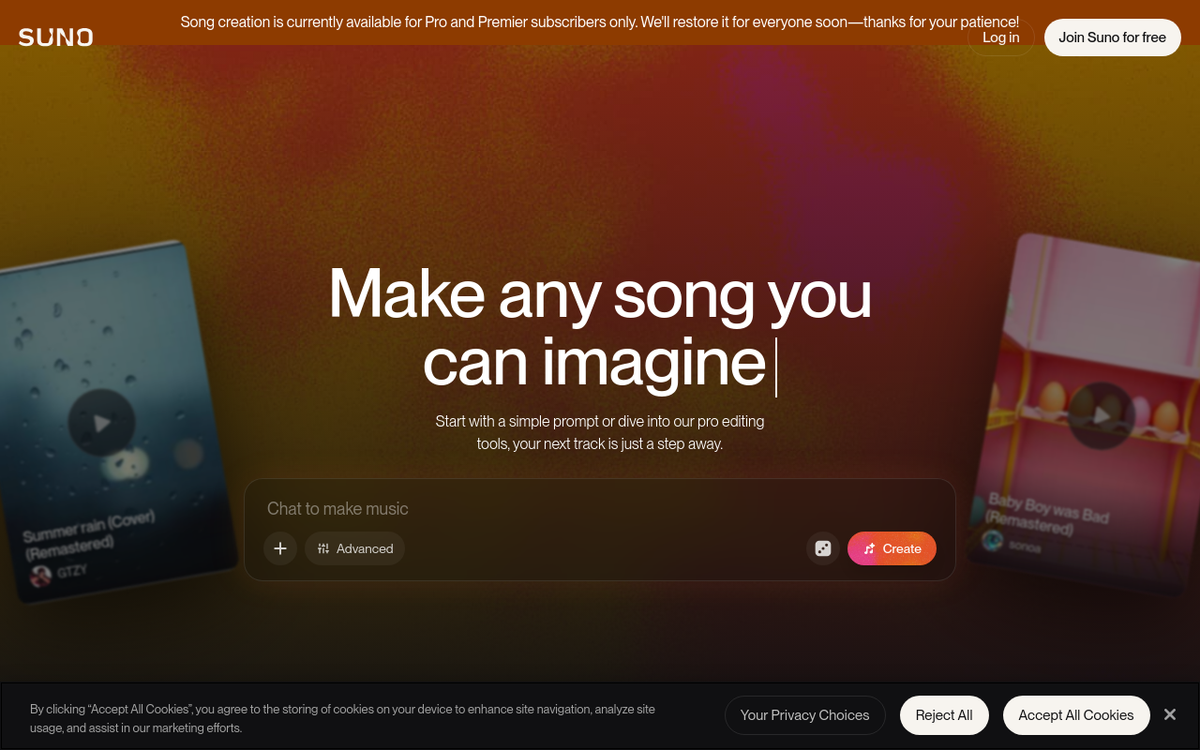
Suno is the 800-pound gorilla of AI music. With over 12 million users and roughly 67% market share, it's the platform most people try first — and for good reason.
The Good Stuff
English vocals are unmatched. Suno v5.5 produces vocals with genuine emotional texture. You get natural vibrato, breathiness, and dynamic range that actually sounds like a person singing with feeling. For pop, rock, hip-hop, and R&B in English, nothing else comes close right now.
It's ridiculously easy to use. Type a description of what you want, maybe paste in some lyrics, hit generate. Within a minute or two, you have a polished track. The learning curve is essentially flat. Your grandma could make a song on Suno, and it would probably sound decent.
Personas keep things consistent. If you're building a brand or character around AI music, Suno's Personas feature lets you maintain a consistent vocal identity across tracks. This is huge for content creators and anyone building a fictional artist.
The ecosystem is massive. 12 million users means a thriving community of shared prompts, techniques, and inspiration. When you hit a wall, someone has probably already figured out a workaround and posted about it.
Technical specs are strong. Version 5.5 brings voice cloning, custom models, 12-stem separation, support for over 1,200 genres, and 44.1kHz output quality.
The Not-So-Good Stuff
No MIDI export. This is the big one. If you want to take a melody or chord progression from Suno into your DAW and tweak it note by note, you're out of luck. What Suno generates stays in Suno's ecosystem.
Credits expire monthly. Use them or lose them. If you have a busy month followed by a quiet one, those unused credits just evaporate.
Limited structural control. Suno excels at generating complete songs quickly, but giving it precise instructions about arrangement — "I want the bridge to modulate up a half step after 8 bars, then drop back for a soft outro" — is hit or miss.
The WMG ownership situation. Suno's deal with Warner Music Group raises questions about how generated music is treated from a rights perspective. For most casual users this doesn't matter, but if you're building a music business on top of Suno, it's worth understanding the implications.
Mureka V9 (MusiCoT): What You Get
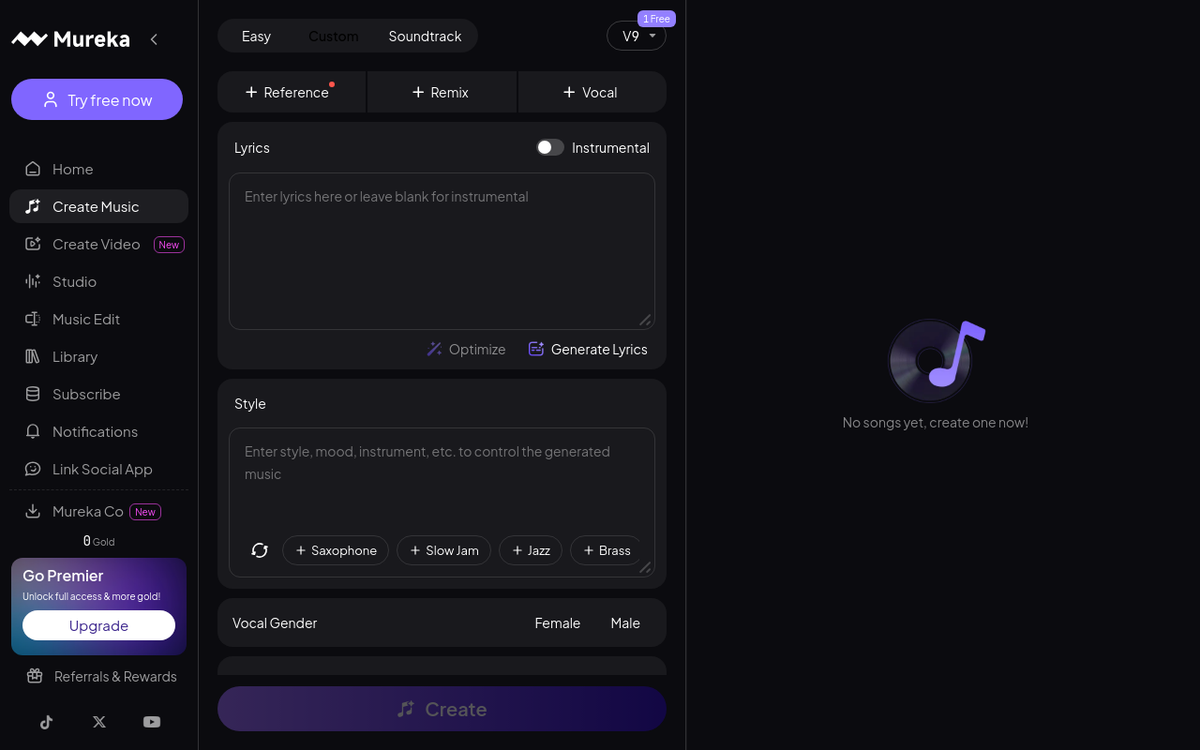
Mureka has been the quieter contender, but V9 and its MusiCoT engine represent a genuine leap forward. With around 10 million users, it's not a scrappy underdog anymore — it's a serious platform with a fundamentally different philosophy.
The Good Stuff
MusiCoT changes the game. MusiCoT stands for Music Chain-of-Thought, and it's Mureka's secret weapon. Instead of generating audio in one pass (like Suno), Mureka first plans the song's structure — verse lengths, chorus placement, key changes, dynamics — then generates the audio to match that plan.
The result is noticeably more coherent compositions, especially for longer or more complex songs.
MIDI export is a killer feature. This is the single biggest differentiator. Mureka can export your generated music as MIDI files, meaning you can pull melodies, basslines, and chord progressions directly into Ableton, Logic, FL Studio, or any other DAW. For producers who use AI as a starting point rather than a finished product, this alone might justify the switch.
Credits don't expire. Buy 400 songs worth of credits, use them over three months if you want. No pressure, no waste. This is a surprisingly big deal for hobbyists and part-time creators who don't produce on a strict schedule.
Multi-language music is excellent. Mureka supports over 10 languages with genuinely good results. If you're making music in Spanish, Japanese, Korean, Hindi, or Mandarin, Mureka handles it with more consistency and authenticity than Suno currently does.
DAW integration is real. Beyond MIDI export, Mureka integrates with tools like Ableton Live. You can use it as part of a professional production workflow rather than a standalone island.
Stem export and AI cover art. Separate your tracks into individual stems for mixing, and generate matching cover art — all within the same platform.
The Not-So-Good Stuff
English vocals aren't quite at Suno's level. Mureka's vocals are good — genuinely good — but they lack the last 10% of emotional expressiveness that Suno nails. The difference is subtle, but if English-language vocal quality is your top priority, you'll notice it.
Fewer genre options. 50+ styles is respectable, but it's a fraction of Suno's 1,200+ genre library. If you work in niche genres, Suno is more likely to have what you need.
Smaller community. 10 million users is nothing to sneeze at, but Suno's larger community means more shared resources, tutorials, and prompt libraries.
Side-by-Side Comparison: Features
| Feature | Suno v5.5 | Mureka V9 |
|---|---|---|
| Users | 12M+ | ~10M |
| Output Quality | 44.1kHz | High fidelity |
| Voice Cloning | Yes (polished, privacy safeguards) | Yes |
| MIDI Export | No | Yes |
| Stem Separation | 12-stem | Yes |
| DAW Integration | No | Yes (Ableton, etc.) |
| Genre Library | 1,200+ | 50+ styles |
| Languages | Best in English | 10+ languages |
| Structural Planning | Standard generation | MusiCoT (plans before generating) |
| Custom Models | Yes | Limited |
| Cover Art Generation | No | Yes (AI-generated) |
| Personas / Identity | Yes (Personas feature) | No |
| Community Size | Largest in AI music | Growing |
Side-by-Side Comparison: Pricing

| Plan | Suno | Mureka |
|---|---|---|
| Free | 50 daily credits (v4.5 only) | Free trial available |
| Basic / Pro | $10/mo — 2,500 credits (~500 songs), commercial license | $10/mo — 400 songs |
| Premium / Pro | $30/mo — 10,000 credits, Studio DAW access | $30/mo — 1,600 songs |
| Extra Credits | Must upgrade plan | $48 per 1,600 songs (on-demand) |
| Credit Expiry | Monthly (use or lose) | Never expire |
| Commercial Use | Yes (Pro and above) | Yes (paid plans) |
The pricing story is more nuanced than it looks. Suno's $10 plan gives you roughly 500 songs worth of credits, while Mureka's $10 plan gives you 400. On paper, Suno offers more volume. But Suno's credits expire every month, while Mureka's stick around forever. If you're a consistent, high-volume creator, Suno's math works out fine. If your creative schedule is irregular, Mureka's no-expiry policy saves you real money over time.
Mureka also offers a pay-as-you-go option at $48 for 1,600 songs, which is handy for project-based work where you don't want a recurring subscription.
Head-to-Head: Who Wins What?
Let's cut through the feature lists and talk about real-world performance based on multiple independent reviews.
English Vocals: Suno Wins
This isn't even close right now. Suno's vocal engine produces the most emotionally convincing AI singing in English. The vibrato feels natural, the breathiness sounds intentional, and the dynamic shifts between quiet verses and powerful choruses actually land. Mureka's English vocals are solid — you wouldn't be embarrassed by them — but they feel slightly more "generated" in comparison.
Non-English Music: Mureka Wins
Flip to any other language, and the story reverses. Mureka's multi-language engine handles tonal languages, complex rhythmic patterns, and non-Western scales with noticeably more authenticity. If you're creating music in Japanese, Korean, Spanish, or Hindi, Mureka is the safer bet.
Structural Coherence: Mureka Wins
MusiCoT makes a real difference here. Songs generated by Mureka tend to have more logical arrangements — bridges that actually bridge, outros that feel like conclusions rather than abrupt stops, and verses that build toward choruses in a musically satisfying way. Suno can achieve this too, but it requires more prompt engineering and more re-rolls.
Production Tools: Mureka Wins
MIDI export alone puts Mureka ahead for anyone with a production workflow. Add DAW integration, stem separation, and AI cover art generation, and Mureka is clearly built for people who want to use AI as part of a larger creative process rather than the entire process.
Ease of Use: Suno Wins
Suno is the iPhone of AI music — it just works. The interface is clean, the defaults are good, and you can go from idea to finished track with minimal friction. Mureka has more powerful tools, but that power comes with a steeper learning curve.
Value for Money: Mureka Wins (for most people)
Non-expiring credits tip the scale. Unless you're generating music every single day without fail, you'll get more actual value from Mureka's pricing structure. The ability to buy extra credits on demand without changing your plan is a nice bonus.
Community and Ecosystem: Suno Wins
Numbers matter. Suno's larger user base means more tutorials, more shared prompts, more community-built tools, and a bigger pool of people to learn from. If you get stuck, help is easier to find.
Voice Cloning: Suno Wins (Slightly)
Both platforms offer voice cloning, but Suno's implementation is more polished in v5.5, with better privacy safeguards and more natural-sounding results.
Which Should You Pick?
Skip the feature comparisons for a second. Here's the honest advice based on who you actually are.
Pick Suno If You...
- Want the simplest possible experience. You have a song idea, you want to hear it in two minutes, and you don't care about MIDI files or DAW workflows. Suno is built for you.
- Focus on English-language music. If English vocals are the core of what you create, Suno's vocal engine is simply better right now.
- Value community and resources. You want to learn from others, share your work, and tap into an established ecosystem.
- Create content consistently. If you're generating music daily or weekly without fail, Suno's credit system works fine and the per-song cost is competitive.
Pick Mureka If You...
- Need MIDI export. Full stop. If you want to bring AI-generated melodies into your DAW and arrange them yourself, Mureka is the only option between these two.
- Work in a DAW-based production workflow. Mureka was built with producers in mind. If Ableton, Logic, or FL Studio is your home base, Mureka fits into your workflow; Suno sits outside it.
- Create music in multiple languages. Mureka's multi-language engine is meaningfully better for non-English music.
- Have an irregular creative schedule. Non-expiring credits mean you're not paying for time you don't use.
- Care about structural coherence. MusiCoT's plan-then-generate approach produces more intentionally structured songs with less prompt engineering.
Pick Both If You...
- Are a professional creator exploring where AI fits in your workflow. Use Suno for quick English-language demos and inspiration, and Mureka when you need MIDI export or more structural control.
- Run a content business that needs both volume (Suno's speed) and flexibility (Mureka's tools).
What About MusicWave.ai?
Both Suno and Mureka focus on generating original songs from scratch. But that's not the only way people want to interact with AI music.
MusicWave.ai takes a different approach entirely. Instead of original generation, it specializes in AI cover songs, advanced stem splitting, and personalized music gifts. Want to hear your favorite song reimagined in a completely different voice? Want to isolate the bass line from a track for practice? Want to create a one-of-a-kind musical gift for someone?
That's MusicWave's territory. It's not competing with Suno or Mureka — it's filling the creative space they don't cover. If your goal is creative transformation rather than generation from scratch, it's worth exploring alongside whichever generator you choose.
FAQ
Is Mureka better than Suno in 2026?
It depends entirely on your use case. Mureka wins on production tools (MIDI export, DAW integration), structural coherence (MusiCoT), multi-language support, and pricing flexibility (non-expiring credits). Suno wins on English vocal quality, ease of use, genre variety, and community size. Neither is universally better — they're optimized for different workflows.
Can I use Suno-generated music commercially?
Yes, with a paid plan. Suno's Pro ($10/month) and Premier ($30/month) plans both include commercial licensing. The free tier is for personal use only. Keep in mind Suno's relationship with Warner Music Group, which may have implications for how generated music is treated in certain commercial contexts.
Does Mureka really export MIDI files?
Yes, and it's genuinely useful. You can export melodies, chord progressions, and other musical elements as MIDI, then import them directly into Ableton, Logic, FL Studio, or any DAW that reads MIDI. This makes Mureka uniquely valuable for producers who want AI as a compositional starting point rather than a finished product.
Which AI music generator is best for non-English songs?
Mureka V9 is the stronger choice for non-English music. It supports over 10 languages with more consistent and authentic results than Suno, particularly for tonal languages and non-Western musical traditions. Suno is improving in this area, but Mureka has a clear lead as of mid-2026.
Are there free AI music generators worth trying?
Both Suno and Mureka offer free tiers, though with limitations. Suno gives you 50 daily credits on the older v4.5 model (not v5.5), while Mureka offers a free trial. For free options, Suno's daily credits provide more ongoing access.
If you want to explore beyond generation — cover songs, stem splitting, personalized music — MusicWave.ai is also worth checking out.
The Bottom Line
The Suno vs Mureka debate doesn't have a single winner because they're building for different people. Suno is the fastest, most accessible way to turn an idea into a polished English-language track. Mureka is the more powerful, more flexible tool for producers who want AI to fit into a professional workflow.
If forced to give one piece of advice: start with whichever one matches how you actually work, not which one has the longer feature list. The best AI music tool is the one you'll actually use consistently.