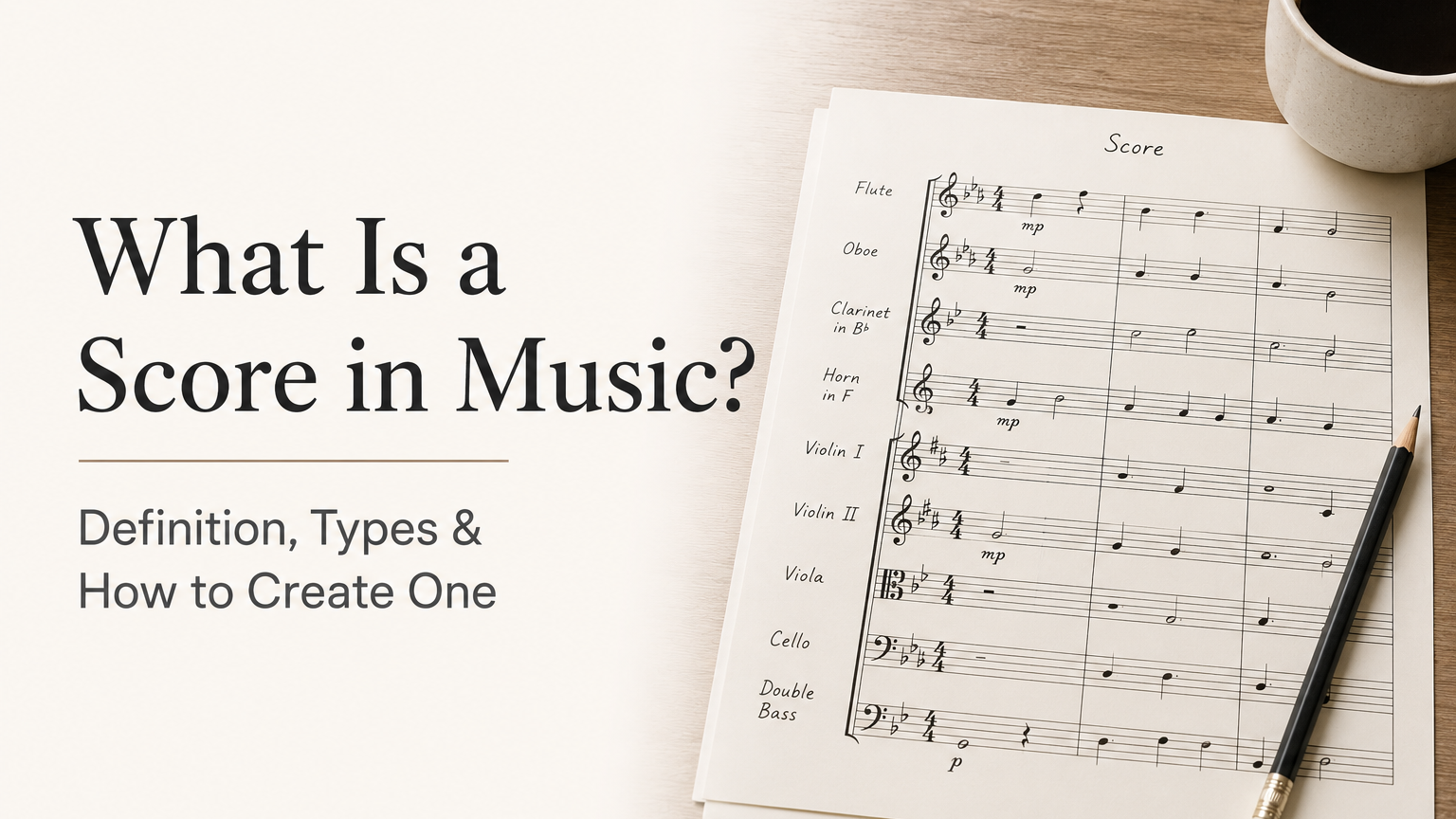
A score in music is the written document that shows every part of a musical composition in one place — every instrument, every note, every rhythm, all organized on the page. Think of it as the complete blueprint that tells musicians exactly what to play, when to play it, and how it should sound.
Whether you've heard the term while watching a behind-the-scenes documentary about your favorite film or stumbled across it in a music theory class, the concept of a musical score is one of those foundational ideas that unlocks a deeper understanding of how music gets made. Let's break it all down.
What Exactly Is a Music Score?
A music score is the master document of a piece of music. It contains all the information a performer or conductor needs: notes, rhythms, dynamics (how loud or soft), tempo (how fast or slow), and which instruments play what.
Here's the key distinction that trips people up: a score is not the same as a "part." A part shows the music for just one instrument — the flute part, the violin part, the trumpet part. A score shows everything at once, stacked vertically so you can see how all the parts fit together.
Imagine you're directing a play. Each actor gets a script with only their lines highlighted. But you, the director, have the full script with everyone's lines, stage directions, and lighting cues. That full script is the score. The individual highlighted scripts are the parts.
Conductors use scores to lead orchestras. Composers use them to write down their ideas. Students use them to study how great music works. And today, anyone with a laptop can create one.
Types of Scores You Should Know
Not all scores look the same. Depending on the purpose and the setting, you'll encounter several different formats.
Full Score (Orchestral Score)
The full score — sometimes called an orchestral score — is the most comprehensive version. It includes a separate staff (line of music) for every single instrument in the ensemble.
For a large symphony orchestra, that could mean 20 or more staves on a single page. Conductors stand at the podium reading from a full score, tracking dozens of instruments simultaneously. It's an impressive skill, and it's why these scores tend to be printed on oversized paper.
Film and TV Score
When people say "film score," they're talking about music composed specifically to accompany visual media. This is where composers like John Williams, Hans Zimmer, and Howard Shore do their work.
A film score isn't just background music. It's carefully timed to match the action, emotion, and pacing of what's happening on screen. The written document for a film score often includes timing marks (called "streamers" and "punches") that sync the music to specific moments in the footage.
Miniature Score (Study Score)
A miniature score contains the same information as a full score, just printed at a smaller size. These pocket-sized versions are popular with music students and anyone who wants to follow along while listening to a recording.
You can find miniature scores for most major classical works at music libraries or through publishers like Bärenreiter and Eulenburg.
Vocal Score
A vocal score takes a work written for voices and orchestra — like an opera or oratorio — and reduces the orchestral parts down to a piano accompaniment. The vocal lines stay as written, but instead of 40 staves of orchestra, you get two staves of piano.
This makes rehearsal practical. Singers can learn their parts with a pianist rather than needing a full orchestra in the room every time they practice.
Lead Sheet
A lead sheet is the most stripped-down version of a score. It shows just the melody (written on a single staff) and chord symbols above it. No fully written-out accompaniment, no arrangement details.
Lead sheets are the standard in jazz and pop music. A jazz musician reads the melody and chords, then improvises and interprets from there. If you've ever seen a "fake book," it's essentially a collection of lead sheets.
Condensed Score
A condensed score takes the full orchestral score and reduces it to fewer staves — usually somewhere between four and eight. It's a shorthand version that gives you the big picture without every individual instrument line.
Composers sometimes write condensed scores as a drafting step before creating the full orchestration. It's also useful for quick reference during rehearsals.
Famous Scores That Shaped Music
Some scores have become legendary — not just for the music they contain, but for the craft and creativity behind them.
Film Scores
The film scoring world has produced some of the most recognizable music of the last century:
- Star Wars (John Williams) — The score that proved orchestral music could define a blockbuster. Williams' use of leitmotifs (recurring musical themes for characters) set the standard for modern film scoring.
- Inception (Hans Zimmer) — Zimmer's score blurred the line between electronic and orchestral music, creating a massive, layered sound that influenced an entire generation of film composers.
- The Lord of the Rings (Howard Shore) — Shore composed over 10 hours of music across the trilogy, weaving together dozens of themes that evolve with the story. It's one of the most ambitious film scores ever written.
Classical Scores
Long before film, composers were creating scores that still move audiences today:
- Beethoven's Symphony No. 9 — The score that introduced a full choir into a symphony for the first time. Beethoven composed it while almost completely deaf, working entirely from his inner ear and the score on paper.
- Mozart's Requiem — Left unfinished at Mozart's death, this score was completed by his student Franz Xaver Süssmayr. The manuscript itself is a fascinating historical document.
Video Game Scores
Modern video game music has earned its place alongside film and classical scores:
- The Elder Scrolls V: Skyrim (Jeremy Soule) — An orchestral score that creates an entire world's atmosphere, performed by a full orchestra and choir.
- Final Fantasy series (Nobuo Uematsu) — Uematsu's scores have been performed in concert halls worldwide, bridging the gap between game music and classical performance.
How to Read a Music Score
Reading a full score might look intimidating at first, but once you understand the layout, it starts to make sense quickly.
The Staff
All Western music notation is built on the staff — five horizontal lines where notes are placed. Higher notes sit higher on the staff, lower notes sit lower. Each instrument gets its own staff (or two staves for piano and harp).
Instrument Order
Instruments in a full score always follow a standard order from top to bottom:
- Woodwinds — flutes, oboes, clarinets, bassoons
- Brass — horns, trumpets, trombones, tubas
- Percussion — timpani, snare drum, cymbals, etc.
- Keyboards/Harp — piano, celesta, harp
- Voices — if the piece includes singers
- Strings — violins, violas, cellos, double basses
This order is consistent whether you're looking at a score from 1790 or 2025. Once you know it, you can navigate any orchestral score.
Key Signatures and Time Signatures
At the beginning of every score, you'll see two important pieces of information:
- Key signature: The sharps or flats listed right after the clef sign, telling you what key the music is in.
- Time signature: Two numbers stacked on top of each other (like 4/4 or 3/4), telling you how beats are organized in each measure.
Dynamic Markings
Throughout the score, you'll find symbols and Italian words that tell performers how loud or soft to play:
- pp (pianissimo) — very soft
- p (piano) — soft
- f (forte) — loud
- ff (fortissimo) — very loud
- crescendo — gradually getting louder
- decrescendo — gradually getting softer
These markings are how a composer controls the emotional shape of the music without being in the room.
How to Create a Score Today
Creating a music score used to require years of training, staff paper, and a very sharp pencil. Today, the tools have evolved dramatically, and the barrier to entry has never been lower.
Notation Software
If you want to write a traditional score — the kind a live musician would read — notation software is where you start.
- [MuseScore](https://musescore.org/) — Free and open-source. It's surprisingly powerful for a tool that costs nothing. You can write for any instrument, play back your score with built-in sounds, and export to PDF or audio. For beginners, this is the place to start.
- [Sibelius](https://www.avid.com/sibelius) — The industry standard for professional composers and publishers. It offers advanced engraving features that make your scores look publication-ready.
- [Finale](https://www.finalemusic.com/) — Another professional-grade option with deep customization. Some composers swear by it for complex orchestral work.
- [Dorico](https://www.steinberg.net/dorico/) — The newest major player, built by former Sibelius developers. It's gaining ground fast with a modern interface and smart defaults.
Digital Audio Workstations (DAWs)
Many modern composers — especially in film, games, and media — work in DAWs rather than traditional notation software. A DAW lets you compose using virtual instruments, hearing realistic playback in real time.
- Logic Pro — Popular with film composers for its built-in orchestral sounds and scoring-to-picture features.
- Ableton Live — Favored in electronic and hybrid scoring for its flexibility with loops, effects, and live performance.
- Cubase — A long-time favorite in the film scoring community, with strong MIDI editing and notation features.
The trade-off: DAWs produce great-sounding demos and final productions, but the notation they generate usually needs cleanup if you want real musicians to read it.
AI-Powered Music Creation
The newest frontier in score creation involves artificial intelligence. Tools like MusicWave.ai can generate musical compositions based on parameters you set — mood, genre, instrumentation, length. For composers who need to iterate quickly or for indie filmmakers who can't afford a full orchestral session, AI music generation is becoming a practical part of the workflow.
You can use AI-generated compositions as starting points, then arrange and refine them into full scores. It's not about replacing human creativity — it's about giving more people access to the starting materials of music creation.
Audio-to-Notation Tools
Another modern option: music sheet maker tools that can convert audio recordings into written notation. These use audio recognition technology to listen to a performance and generate a score from it. They're not perfect — complex polyphonic music is still challenging — but for simple melodies and lead sheets, they're genuinely useful.
Film Scoring: How Music Meets Picture
Film scoring is one of the most visible applications of the music score in modern culture. Here's how it actually works behind the scenes.
The Spotting Session
After a film is edited (or sometimes during editing), the director and composer sit down together for a "spotting session." They watch the film scene by scene and decide where music should go, what mood it should create, and how long each cue should last.
This is where creative decisions get made. Should the music start before the villain appears, building tension? Should it cut out suddenly for impact? Every choice shapes how the audience experiences the story.
Temp Tracks
Before the final score is composed, editors often place existing music into the film as a placeholder. These "temp tracks" help everyone involved get a sense of what the music might feel like.
The danger of temp tracks is that directors sometimes fall in love with them, then ask the composer to write something that sounds almost identical — which can lead to creative frustration and, occasionally, legal trouble.
The Changing Landscape
Film scoring is evolving. Budgets for many productions don't allow for a 90-piece orchestra anymore. Composers increasingly use a combination of live players, virtual instruments, and AI-generated elements to create scores that sound massive on a fraction of the budget.
For independent filmmakers, this shift is a gift. Tools that would have been unimaginable 20 years ago — from realistic orchestral sample libraries to AI composition platforms like MusicWave.ai — mean that compelling original music is within reach for projects of any size.
Frequently Asked Questions
What is the difference between a score and sheet music?
"Sheet music" is a general term for any printed music — it could be a single part, a lead sheet, or a full score. A "score" specifically refers to the document that shows all parts of a composition together. All scores are sheet music, but not all sheet music is a score.
Do you need to read music to understand a score?
To fully read a score, yes — you need a working knowledge of music notation. However, even without formal training, you can learn to follow a score at a basic level by tracking the visual patterns of notes moving up and down while listening to a recording. It's a great way to train your ear.
What software do most film composers use?
Most professional film composers use a DAW like Logic Pro or Cubase for composing and producing, often combined with notation software like Sibelius or Dorico when they need to create printed parts for live musicians. The specific toolchain varies by composer, but that combination covers most workflows.
How long does it take to compose a film score?
It depends on the project, but a typical feature film score takes anywhere from 4 to 12 weeks to compose, orchestrate, record, and mix. Some high-profile projects take much longer. Hans Zimmer reportedly worked on Interstellar's score for over a year.
Can AI create a music score?
Yes. AI tools can now generate musical compositions that can serve as the foundation for a score.
They won't replace the nuanced creative decisions of an experienced composer, but they can accelerate the process significantly — generating ideas, creating variations, and producing drafts that humans can then refine and arrange into finished scores.
Ready to explore what AI can do for your music? [MusicWave.ai](https://musicwave.ai) helps you generate original compositions that you can use as starting points for your own scores — whether you're scoring a film, building a portfolio, or just curious about what's possible.