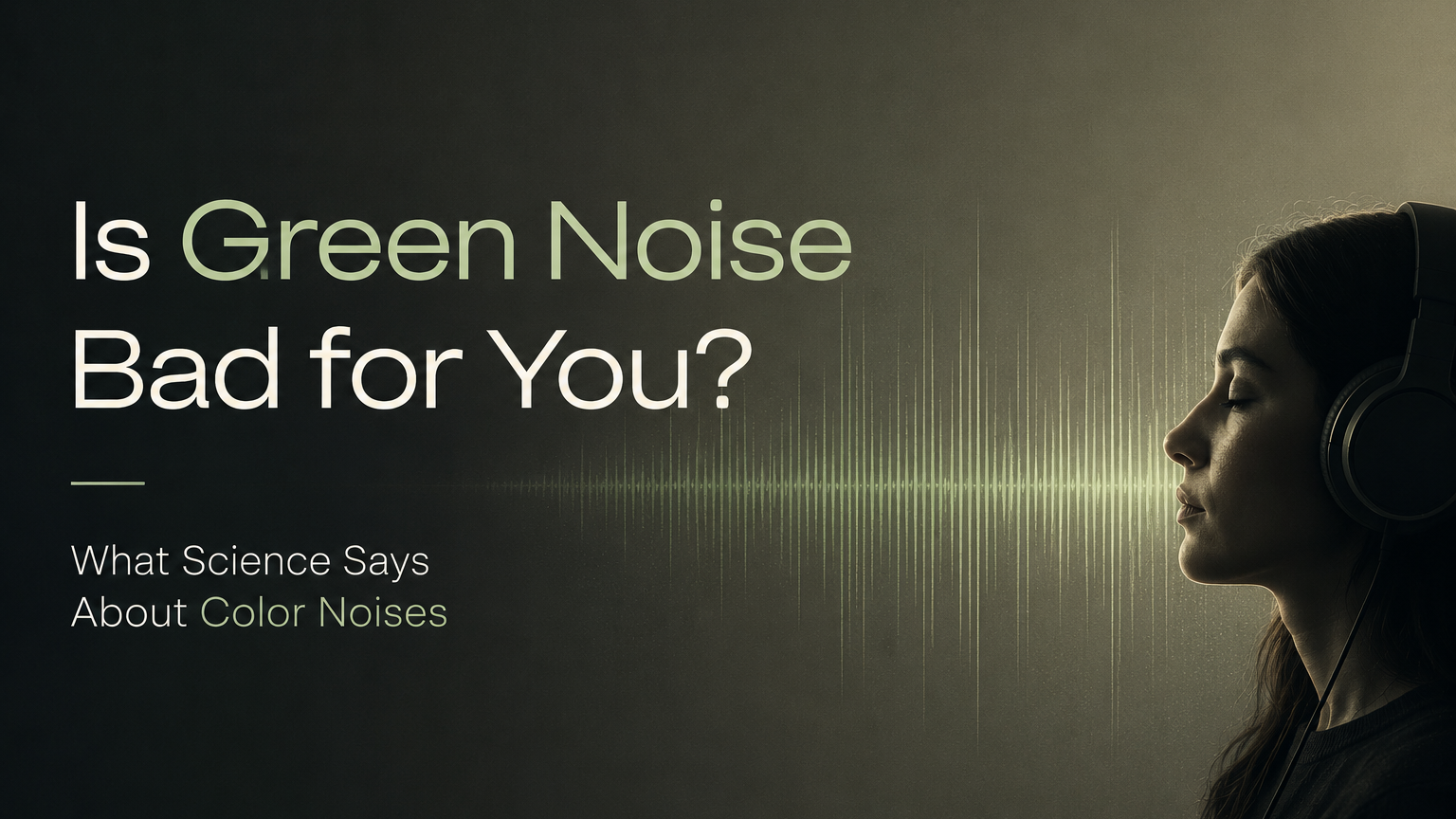
If you've been scrolling through sleep playlists or wellness TikTok, you've probably come across green noise.
It's the latest color noise trending alongside white, pink, and brown noise — and naturally, people are asking: is green noise bad for you?
The short answer: no, green noise isn't bad for you. There's no scientific evidence suggesting green noise is specifically harmful.
But there's an important caveat that applies to all broadband noise, and it's worth understanding before you hit play every night.
Let's break down what green noise actually is, how it compares to other noise colors, and what sleep researchers want you to know.
What Is Green Noise, Exactly?
Green noise is a broadband sound that emphasizes mid-range frequencies. Think of the sounds you hear in nature — a flowing river, a gentle breeze through trees, steady rainfall. That's the territory green noise occupies.
Unlike white noise (which distributes energy equally across all frequencies) or brown noise (which leans heavily into bass), green noise sits somewhere in the middle. It's softer than white noise but not as deep as brown noise.
Here's the thing, though: green noise isn't an official term in audio engineering or acoustics.
You won't find it in textbooks next to white or pink noise, which have precise mathematical definitions. Green noise emerged from the wellness and sleep community as a way to describe that particular mid-frequency, nature-inspired sound profile.
That doesn't make it less useful. It just means the research specifically on "green noise" is limited compared to its more established cousins.
So, Is Green Noise Bad for You?
No current research points to green noise being harmful. If you find it relaxing and it helps you fall asleep or focus, there's no reason to stop using it.
However, a study highlighted by Penn Medicine found something that applies to green noise and every other color noise: broadband noise played at around 50 dB reduced REM sleep by nearly 19 minutes per night.
That's significant. REM sleep is the stage where your brain consolidates memories, processes emotions, and essentially "resets" for the next day. Losing 19 minutes of it regularly can add up.
Why This Matters
The Penn Medicine finding isn't anti-green-noise. It's anti-any-noise-played-all-night-at-moderate-volume. White noise, pink noise, brown noise — they all carry the same risk if you're running them continuously through the night at levels that interfere with your sleep architecture.
The researchers were especially cautious about children, who need significantly more REM sleep than adults for healthy brain development.
The Takeaway
Green noise itself isn't the problem. The habit of playing any broadband sound all night, every night, at noticeable volume — that's where sleep scientists urge caution.
All Noise Colors Explained
If you've been confused by the growing rainbow of noise options, you're not alone. Here's what each color actually means and what it sounds like.
White Noise
White noise distributes equal energy across every audible frequency. It sounds like TV static or a fan running on high. It's the original "sleep sound" and is widely used in sound machines.
White noise is effective at masking environmental sounds — barking dogs, traffic, a snoring partner — because it covers the entire frequency range. It's the broadest, most uniform noise color.
Pink Noise
Pink noise reduces the higher frequencies, so it sounds deeper and more balanced than white noise. Imagine steady rain on a rooftop or wind rustling through leaves.
Pink noise has the most research behind it for sleep. Studies have shown it can enhance deep sleep and promote slow brainwave activity, which is associated with more restorative rest. If you're choosing a noise color for sleep specifically, pink noise has the strongest evidence in its favor.
Brown Noise
Also called Brownian noise (after Robert Brown, not the color), brown noise emphasizes even lower frequencies. It sounds like a deep river current, strong wind, or a distant thunderstorm.
Brown noise has become a favorite for focus and concentration, especially among people with ADHD who report it helps quiet mental chatter. One study found that insomniacs using brown noise fell asleep 38% faster than without any sound.
Green Noise
Green noise sits in the mid-range, overlapping with pink noise but centering on frequencies that mimic natural ambiance. It's calming and organic-sounding, which is why it's gained popularity in relaxation and meditation contexts.
The research specific to green noise is still catching up, but its frequency profile is similar enough to pink noise that many of the same benefits likely apply.
Blue Noise
Blue noise boosts higher frequencies while reducing lower ones. It sounds like a high-pitched hiss — think of water spraying from a hose nozzle.
Blue noise is rarely used for sleep or relaxation. It shows up more in audio engineering and signal processing than in wellness applications.
Violet Noise
Violet noise (sometimes called purple noise) goes even further into high-frequency territory. It's the sharpest and most treble-heavy color noise.
While not pleasant for most people as a sleep aid, violet noise has found a niche in tinnitus masking, where the high-frequency emphasis can help offset the ringing or buzzing sounds that tinnitus sufferers experience.
Noise Colors Comparison Table
| Noise Color | Frequency Profile | Sounds Like | Best For | Research Level |
|---|---|---|---|---|
| White | Equal across all frequencies | TV static, fan | Masking loud environments | Well-studied |
| Pink | Reduced highs, balanced | Steady rainfall | Sleep (deep sleep boost) | Most studied for sleep |
| Brown | Heavy bass, deep | River current, thunder | Focus, concentration | Moderate research |
| Green | Mid-range, nature-like | Flowing stream, breeze | Calming, relaxation | Limited research |
| Blue | Boosted highs | Hissing spray | Audio engineering | Minimal sleep research |
| Violet | Very high frequency | Sharp hiss | Tinnitus masking | Niche research |
Green Noise vs. White Noise: Which Is Better?
This depends entirely on what you need it for.
White noise is better for blocking out disruptive environmental sounds. Its even frequency distribution means it covers everything, from low rumbles to high-pitched noises. If you live on a busy street or share a wall with noisy neighbors, white noise is your best bet.
Green noise is better for relaxation and creating a calming atmosphere. Its mid-range, nature-inspired profile feels less harsh than white noise, which some people find grating over time. If you're using sound for meditation, winding down before bed, or creating a peaceful work environment, green noise may feel more pleasant.
Neither is objectively "better." It comes down to your ears, your environment, and your goals.
Brown Noise vs. Pink Noise: The Deep Sleep Debate
These two get compared frequently because they're both popular for sleep, but they work differently.
Pink noise has the research advantage. Multiple studies have linked it to enhanced slow-wave sleep (the deepest, most restorative stage) and improved memory consolidation. If you're optimizing for sleep quality based on evidence, pink noise is the stronger choice.
Brown noise leans deeper and is often preferred by people who want a more immersive, "cocooning" sound. The 38% faster sleep onset finding makes it attractive for people who struggle with falling asleep, even if the research base is smaller than pink noise.
Some people layer both — using brown noise to fall asleep and switching to pink noise (or silence) for the rest of the night. Experimentation is key.
How to Use Color Noise Safely
Based on what sleep researchers recommend, here are practical guidelines for using any color noise:
Keep the Volume Low
Stay below 60-70 dB, which is roughly the level of a normal conversation. If you have to raise your voice to talk over your sound machine, it's too loud.
When using headphones or earbuds, go even lower. Prolonged exposure to sound directly in your ear canal carries more risk than ambient room speakers.
Use a Timer
Instead of running noise all night, set a timer for 30-60 minutes. This gives you the benefit of falling asleep with sound while avoiding the potential REM sleep disruption that comes with continuous overnight exposure.
Most sound machine apps and devices have built-in timer functions. Use them.
Take Breaks
If you use noise for focus during the day and sleep at night, your ears are getting a lot of broadband sound exposure. Build in quiet periods. Your auditory system needs rest just like the rest of your body.
Be Especially Careful with Children
Given the Penn Medicine findings about REM sleep reduction, be conservative with noise machines in children's rooms. If you use one, keep it at the lowest effective volume, place it away from the crib or bed, and use a timer.
Best Noise Color for Your Needs
Not sure where to start? Here's a quick guide:
- Trouble sleeping in a noisy environment? Start with white noise.
- Want deeper, more restorative sleep? Try pink noise.
- Need help focusing or studying? Brown noise is worth trying.
- Looking for calm, nature-inspired relaxation? Green noise is your match.
- Dealing with tinnitus? Experiment with pink or violet noise.
The "best" noise color is the one that works for you. Individual preferences vary widely, and what feels soothing to one person may feel irritating to another. Don't be afraid to experiment.
If you want to go beyond standard noise colors and create your own custom ambient soundscapes — blending nature sounds, adjusting frequencies, or layering textures to match your exact preferences — tools like MusicWave.ai let you generate personalized soundscapes using AI, so you're not limited to preset options.
Frequently Asked Questions
Is it safe to listen to green noise every night?
Green noise itself is safe, but playing any broadband sound all night may reduce your REM sleep by up to 19 minutes, according to research highlighted by Penn Medicine. Using a timer to turn off the sound after you fall asleep is a simple way to get the benefits while protecting your sleep quality.
What's the difference between green noise and pink noise?
Both emphasize lower-to-mid frequencies, but pink noise follows a specific mathematical curve (power decreases as frequency increases), while green noise is a looser term that describes mid-range, nature-like sounds. Pink noise has significantly more scientific research behind it, particularly for sleep benefits.
Can green noise help with anxiety?
There's no direct clinical research on green noise and anxiety, but mid-frequency nature-like sounds have been shown in broader research to activate the parasympathetic nervous system (your body's "rest and digest" mode). Many people report finding green noise calming, which aligns with the well-documented stress-reducing effects of nature sounds.
Is green noise or brown noise better for ADHD?
Brown noise tends to be more popular in the ADHD community. Its deep, immersive quality may help reduce the mental "static" that many people with ADHD experience. Green noise is typically described as more calming than focusing. That said, individual responses vary — some people with ADHD prefer pink or even white noise. Try a few and see what clicks.
Should I use speakers or headphones for sleep noise?
Speakers are generally the safer option for overnight use. They create ambient sound without the risks of prolonged direct-ear exposure. If you prefer headphones, use them at a lower volume and ideally with a timer so they're not running all night. Sleep-specific headband headphones can be a good middle ground.
The Bottom Line
Green noise isn't bad for you. No science says it is. It's a pleasant, nature-inspired sound that many people find genuinely relaxing and helpful for sleep or focus.
The only real caution — and this applies to white, pink, brown, and every other noise color — is about volume and duration. Keep it reasonable, use a timer, and give your ears (and your REM sleep) a break.
If green noise is your thing, enjoy it. Just be smart about how you use it.