The AI music statistics that matter most: Deezer gets nearly 90,000 fully AI-generated tracks a day, over half its new deliveries on peak days, yet they draw 1-3% of streams (October 2026). Suno reported 2 million paid subscribers and $300 million in annual recurring revenue (February 2026). Spotify pulled 50 million-plus slop and spam tracks from recommendations in 2026.
We checked every number on 31 October 2026, and we update this page as new data lands. Each figure carries its date and a link to where it came from, so you can check it yourself.
One disclosure: we make an AI music generator, MusicWave.ai, which you can try free. That gives us a stake in this topic, so we stick to published figures and name whoever made each forecast.
AI music statistics at a glance
- Uploads vs listening: Deezer receives nearly 90,000 fully AI-generated tracks a day, more than 50% of new deliveries on peak days, but they get only 1-3% of streams, and up to 85% of those streams were fraudulent in 2025 (Deezer, October 2026).
- Growth: that's up from about 10,000 a day in January 2025 (Deezer), roughly nine times as many in a year and a half.
- Spotify: more than 50 million slop and spam tracks taken out of recommendations in 2026, on top of 75 million-plus spammy tracks removed outright (Spotify, 20 October 2026).
- Suno: more than 100 million people have used it and more than 2 million pay (Forbes, February 2026). It's valued at $5.4 billion after a $400 million-plus round (Suno, June 2026).
- People making AI music: 60 million people used AI to create music in 2024, about 10% of music consumers (IMS Business Report 2025, via DJ Mag).
- Listeners: 97% of 9,000 people in eight countries couldn't tell fully AI-made songs from human ones in a blind test, and 80% want AI music labeled (Deezer/Ipsos, November 2025).
- Creators' income: a study for CISAC forecasts that 24% of music creators' revenues are at risk by 2028 (CISAC, December 2024).
- Lawsuits: Warner has settled with Suno and Udio, and Universal with Udio, but Universal and Sony filed a second suit against Suno in September 2026.
- Our own data: about 1 in 8 songs people described on MusicWave was made for a specific person or occasion (MusicWave study, October 2026).
AI music platforms by the numbers
Most AI music companies keep their user and revenue numbers private. This table shows what each one has said in public, and when.
| Platform | Users | Paying subscribers | Revenue | Valuation or funding | Current model |
|---|---|---|---|---|---|
| Suno | 100M+ (Feb 2026) | 2M+ (Feb 2026) | $300M annual recurring (Feb 2026) | $5.4B (Jun 2026) | v6 (Sep 2026) |
| Udio | Not disclosed | Not disclosed | Not disclosed | $10M seed round (Apr 2024) | v1.5 Allegro (Mar 2025) |
| ElevenLabs (Eleven Music) | Not disclosed for music | Not disclosed | $330M+ annual recurring, whole company (2025) | $11B (Feb 2026) | Music v2.5 (Sep 2026) |
| Mureka (Kunlun Tech) | Nearly 10M, company claim (Oct 2026) | Not disclosed | Not disclosed | Not disclosed | V9.5 (Aug 2026) |
| Google (Gemini app, Flow Music) | Not disclosed for music | Not disclosed | Not disclosed | Not applicable | Lyria 3.5 (Jul 2026) |
| Stability AI (Stable Audio) | Not disclosed | Not disclosed | Not disclosed | Raised $76M (Aug 2026) | Stable Audio 3.0 (May 2026) |
| MiniMax (MiniMax Audio) | Not disclosed | Not disclosed | Not disclosed | Not disclosed for music | Music 3.0 (Jul 2026) |
| Soundverse | 3.1M+ creators, company claim (Oct 2026) | Not disclosed | Not disclosed | Not disclosed | Its own v5 to v7 models |
Sources for this table:
- Suno: users and subscribers from CEO Mikey Shulman via Forbes and TechCrunch, valuation from Suno, model from Suno's v6 launch.
- Udio: Wikipedia.
- ElevenLabs: funding and revenue, Music v2.5.
- Mureka: developer docs, changelog.
- Google: Lyria 3.5.
- Stability AI: funding, Stable Audio 3.
- MiniMax: Music 3.0.
- Soundverse: soundverse.ai.
Suno users, subscribers and valuation
Suno had 10 million users when it raised $125 million in May 2024 (Boston Globe), at a valuation TechCrunch puts at about $500 million. In November 2025 it raised $250 million at $2.45 billion and said nearly 100 million people had made music on it (Suno).
Revenue moved just as fast: about $200 million a year in November 2025, as Suno told the Wall Street Journal (TechCrunch), then $300 million in annual recurring revenue by February 2026 (TechCrunch). In October 2026 Shulman said Suno had grown well past those numbers, without giving new ones (Music Business Worldwide).
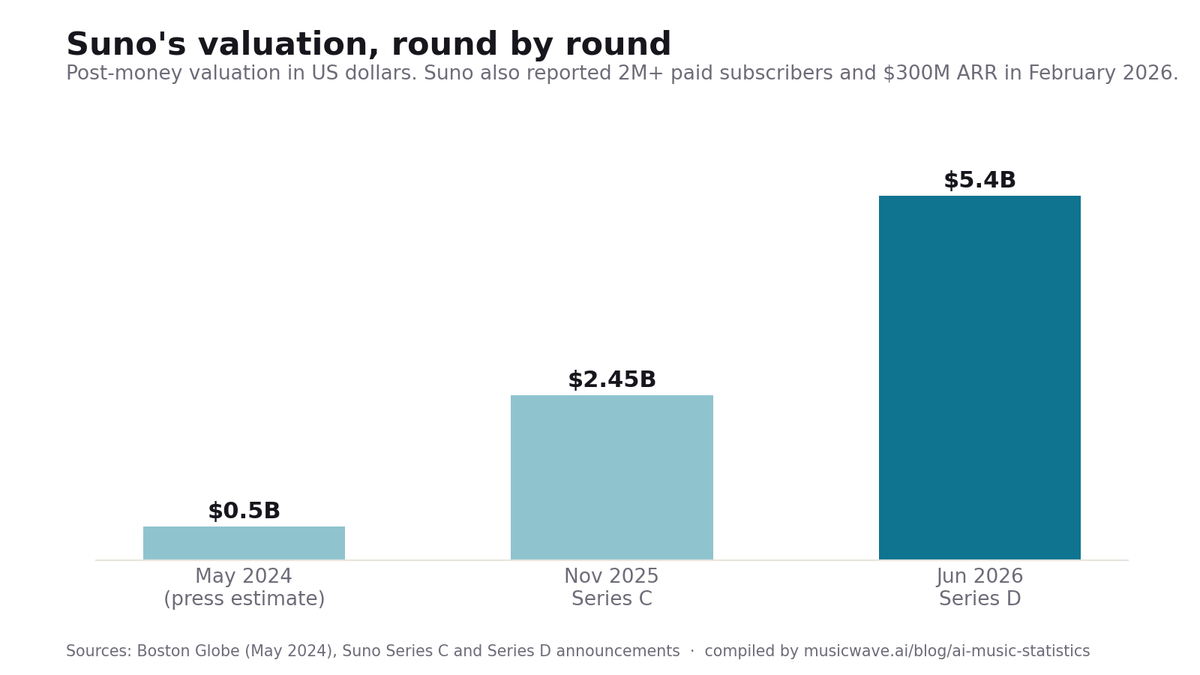
The output is huge. Billboard reported in November 2025 that Suno users were making about 7 million songs a day, a Spotify catalog's worth every two weeks (Forbes).
Udio's status
Udio has been listen-only since it settled with Universal on 29 October 2025: downloads are off (Udio), and its terms limit songs to personal, non-commercial use (Udio terms). We compare the two in Suno vs Udio, and the wider field in our guide to the best AI music generators.
AI music on streaming services
Most AI-generated music statistics you'll see quoted come from Deezer, which has published a count of fully AI-generated uploads every few months since January 2025. Spotify and Apple Music haven't published a comparable series, so Deezer's numbers are the closest thing to a public yardstick.
Deezer's AI upload numbers over time
| Date | Fully AI tracks a day | Share of new deliveries | Share of streams |
|---|---|---|---|
| Jan 2025 | About 10,000 | About 10% | Not given |
| Apr 2025 | 20,000+ | 18%+ | Not given |
| Jun 2025 | 20,000+ | Nearly 18% | Not given |
| Sep 2025 | 30,000+ | 28%+ | About 0.5% |
| Nov 2025 | 50,000+ | 34%+ | About 0.5% |
| Jan 2026 | About 60,000 | About 39% | Up to 3% |
| Apr 2026 | Almost 75,000 | About 44% | 1-3% |
| Jul 2026 | Nearly 90,000 | 50%+ on peak days | 1-3% |
| Oct 2026 | Nearly 90,000 | 50%+ on peak days | 1-3% |
Every row is Deezer's own figure, from its newsroom posts of January 2025, April 2025, June 2025, September 2025, November 2025, January 2026, April 2026, July 2026 and October 2026. Deezer's figures cover fully AI-generated tracks only, so songs where people used AI for part of the work aren't in them.
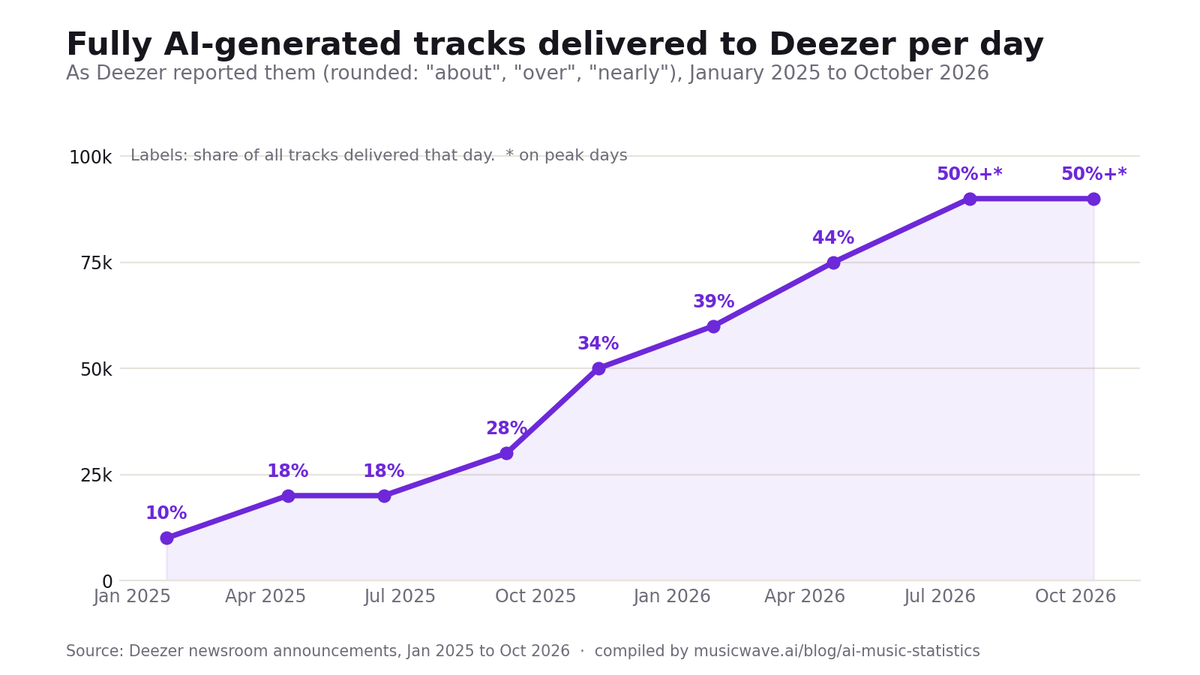
Daily AI uploads grew about ninefold in a year and a half, and by April 2026 that added up to more than 2 million AI tracks a month (Deezer). Listening hasn't followed: fully AI tracks drew about 0.5% of Deezer streams in late 2025 and 1-3% in 2026.
Much of that listening isn't real. Deezer says up to 85% of the streams on fully AI tracks in 2025 were fraudulent, meaning fake plays designed to collect royalties (Deezer).
AI uploads also pile onto big events. Before the 2026 World Cup, more than 70% of the 270-plus tracks titled "World Cup 2026" on Deezer were tagged as AI (Deezer, June 2026).
How Deezer tags and detects AI music
Deezer switched on its detection tool in January 2025. It flags tracks made with generators such as Suno and Udio, and Deezer filed two patent applications for it in December 2024 (Deezer).
Since 20 June 2025, albums with fully AI-generated tracks carry a label, and those tracks are kept out of algorithmic and editorial recommendations (Deezer). Deezer detected and tagged more than 13.4 million AI tracks in 2025 (Deezer), and by October 2026 more than 14 million albums carried the label (Deezer).
More than 42 million AI tracks were excluded from recommendations between January 2025 and August 2026 (Deezer). Fraudulent streams are demonetized, and since April 2026 Deezer no longer stores hi-res versions of AI tracks (Deezer).
Deezer has licensed the detector to other companies since January 2026, after tests with the French rights society SACEM (Deezer). It claims 99.8% accuracy: about 2 AI tracks in 1,000 slip through, and fewer than 1 human-made track in 10,000 gets flagged by mistake (Deezer, October 2026).
Next is an on/off setting that hides fully AI-generated music, including from search, due before the end of 2026 (Deezer).
Spotify's spam removal and AI rules
In September 2025 Spotify said it had removed more than 75 million spammy tracks in the previous 12 months, as AI tools made mass uploads easy (Spotify). It also banned AI voice clones of artists who haven't agreed to them and began rolling out a spam filter for mass uploads and duplicates.
AI credits, which let artists disclose AI use through their label or distributor, went into beta on 16 April 2026. Artists now submit tens of thousands of them a day (Spotify).
In August 2026 Spotify announced an AI Persona badge, shown from mid-September, for artist profiles whose public identity is AI-generated, and it keeps those profiles out of editorial and algorithmic recommendations by default (Spotify). AI personas also weren't eligible for the Verified by Spotify badge when it launched in April 2026 (Spotify).
Its one-year update on 20 October 2026 counted more than 50 million slop and spam tracks taken out of recommendations in 2026, and thousands of AI Personas labeled (Spotify). Tracks likely to be AI-generated were 10 times more likely to fall below 1,000 streams a year, the level a track needs before it earns royalties.
So Spotify isn't banning AI music. It's cutting the reach of spam and impersonation, and licensing AI features of its own (see the money section).
Apple Music, labels and the charts
An Apple Music executive has said more than a third of tracks uploaded to Apple Music are fully AI-generated, a figure IFPI repeated in July 2026 (IFPI). That same month, IFPI, the RIAA, the Grammys, SAG-AFTRA and indie-label groups agreed on two voluntary labels for recordings, AI-Generated and AI-Assisted.
Weeks later IFPI set rules for its own charts and more than 20 national ones (IFPI). An AI-made recording counts only if the AI service was authorized, the track is largely human-made and there's no stream manipulation, so purely synthetic tracks are out.
AI "artists" that charted or signed deals
- July 2025: The Velvet Sundown passed 1 million monthly Spotify listeners before its bio was changed to describe it as a synthetic project steered by humans (Wikipedia).
- July 2025: Hallwood Media signed imoliver, a Suno user it calls an AI music designer; his song "Stone" had over 3 million streams on Suno (The Fader).
- September 2025: Xania Monet, whose lyrics are written by Telisha Jones and whose music is made with Suno, signed a multimillion-dollar deal with Hallwood after a bidding war with offers reportedly reaching $3 million (Wikipedia).
- September to November 2025: Monet's "How Was I Supposed to Know?" topped Billboard's R&B Digital Song Sales chart, and she became the first known AI artist on a Billboard radio chart, entering Adult R&B Airplay at number 30. Billboard counted at least six AI or AI-assisted acts debuting on its charts in a few months (Billboard).
- November 2025: Breaking Rust's "Walk My Walk" topped Billboard's Country Digital Song Sales chart, though TIME noted a few thousand purchases can top that chart and the song wasn't on Spotify's or Apple Music's daily country charts (TIME).
What listeners think about AI music
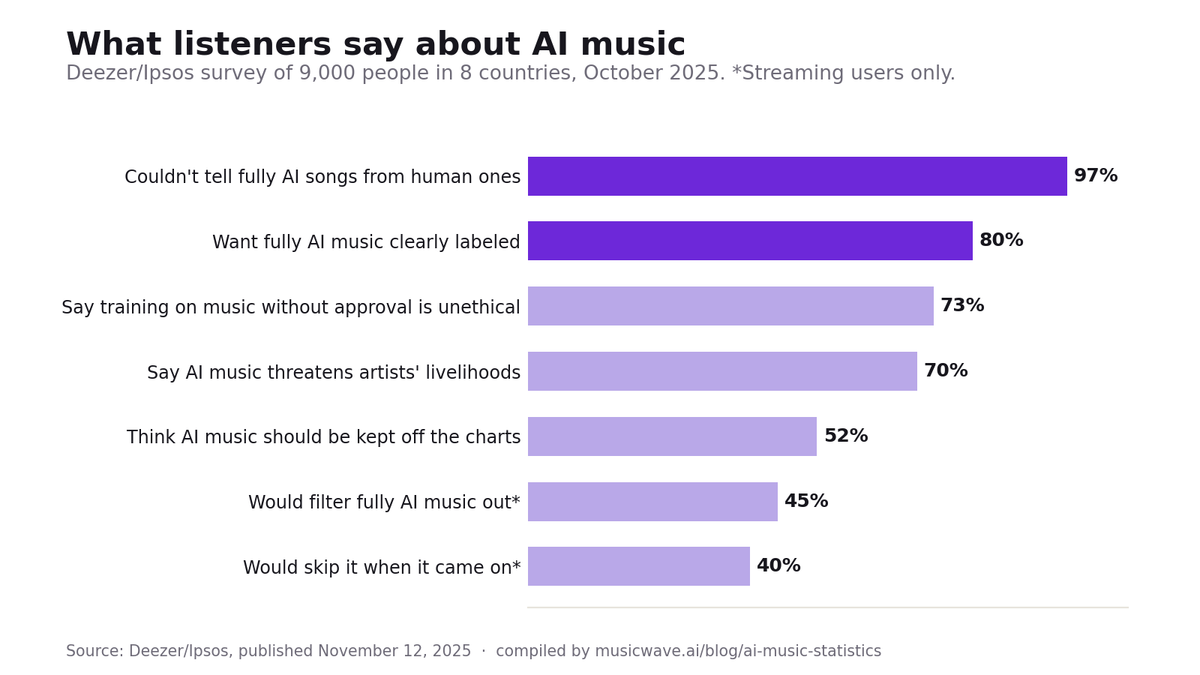
Deezer and Ipsos polled 9,000 adults aged 18 to 65 in eight countries, including the US, UK, Brazil and Japan, between 6 and 10 October 2025 (Deezer/Ipsos). Here's what they found:
- 97% failed a blind test with two fully AI songs and one human-made song, and 52% said not being able to tell made them uncomfortable.
- 80% want fully AI-generated music clearly labeled, and 45% of streaming users would filter it out.
- 66% of streaming users would try it at least once out of curiosity, and 40% would skip it when it came on.
- 70% think it threatens artists' livelihoods, and 69% think it should pay less than human-made music.
- 52% think it should be kept off the charts; only 11% would treat it equally there.
- 65% think AI shouldn't be allowed to train on copyrighted music, and 73% call using it without approval unethical.
IFPI's survey of more than 43,000 people in 26 countries (August to October 2023) found the same instincts (IFPI). 79% said human creativity remains essential to music, and among fans who knew what AI can do, 76% said an artist's music or voice shouldn't be fed to AI without permission.
So far, behavior matches the answers. Fully AI tracks are more than half of Deezer's new deliveries on peak days but only 1-3% of what people play.
How musicians and creators use AI
Surveys of music makers disagree a lot, mostly because "using AI" can mean anything from cleaning up a vocal to generating a whole song.
GEMA and SACEM, the German and French rights societies, had Goldmedia survey more than 15,000 members (GEMA, January 2024). 35% had used AI in their work (51% of those under 35), 71% feared it would cost them income, and 64% said the risks outweigh the opportunities.
Water & Music and Moises surveyed 1,525 musicians in late 2025, about 80% of them Moises users (Water & Music/Moises, March 2026). 67% had used AI for music work (78% of professionals, 60% of hobbyists). Among AI users, 71% used it for stem separation and 24% had generated a full song from a text prompt.
In the same survey, 26% of musicians who earn from music said AI had raised their income and fewer than 4% said it had cut it. Among AI users, authenticity (58%) and copyright (55%) were the top worries.
Sound On Sound's survey for Sonarworks reached almost 1,200 creators, most of them working pros (Sound On Sound, February 2026). About 1 in 5 use AI regularly and about half use it occasionally or are just experimenting. Two-thirds call ethically sourced training data very important, and only 6% would hide their AI use.
Across these surveys, the most common uses are practical jobs like separating stems and tedious editing, not typing a prompt and releasing the result.
The money: AI music market size and deal terms
What's been raised and earned
For scale, recorded music earned $31.7 billion worldwide in 2025, up 6.4% (IFPI, March 2026). Suno's $300 million in annual recurring revenue would be about 1% of that, by our rough math.
Investors are betting on growth. Suno has raised more than $819 million in total, according to PitchBook data cited by TechCrunch in September 2026.
ElevenLabs, whose music tools sit beside its voice products, raised $500 million at an $11 billion valuation in February 2026 and reported more than $330 million in annual recurring revenue for 2025 across everything it sells (ElevenLabs). In August 2026 Stability AI raised $76 million in a round whose new investors included Universal, Warner, Sony Music and EA (Stability AI).
AI music market forecasts, and who made them
CISAC, the global body for authors' societies, commissioned PMP Strategy to model the market (CISAC, December 2024). It forecast generative AI music services' revenue rising from €0.1 billion in 2023 to €4 billion a year by 2028, with 24% of music creators' revenues at risk by then and a cumulative €10 billion loss for them over five years.
The same study projected that AI music could equal about 20% of streaming services' revenue and 60% of music-library revenue by 2028. Goldmedia's study for GEMA and SACEM forecast a generative AI music market above $3 billion by 2028, with 27% of their members' revenue at risk by 2028 (GEMA).
Commercial market-research firms publish other totals, but they define the market differently and keep their methods behind paywalls, so we've left them out.
Reported deal terms
Warner's settlement with Suno on 25 November 2025 came with Suno buying the concert app Songkick from Warner, licensed models promised for 2026, artist opt-in for voices and likenesses, and download limits (Music Week). The limits arrived on 3 September 2026: 20 downloads a month on Pro and 60 on Premier (Suno).
Spotify's deal with Universal (21 May 2026) licenses an AI tool for fan covers and remixes, planned as a paid add-on to Premium, with artists sharing the revenue (Spotify). Merlin, Kobalt and Believe signed similar deals by October (Spotify).
None of the announcements we read disclosed royalty rates. The clearest dollar figures come from court: US law allows up to $150,000 per work for willful infringement (US Code), so Reservoir's 1,050 works could in theory mean up to $157.5 million in statutory damages.
AI music lawsuits, settlements and licensing deals: the timeline
Here are the main cases and deals, oldest first. "Settled" means the label dropped its claims in return for a license, and "not final" means the ruling can still be appealed.
| Date | Parties | What happened | Source |
|---|---|---|---|
| 24 Jun 2024 | Universal, Sony and Warner v Suno and Udio | The majors sue both in US federal courts, seeking up to $150,000 per infringed recording | Wikipedia |
| 21 Jan 2025 | GEMA v Suno | Germany's music rights society sues Suno in Munich | GEMA |
| 5 Aug 2025 | ElevenLabs with Merlin and Kobalt | Eleven Music launches with indie-label and publishing licenses | ElevenLabs (Business Wire) |
| 16 Oct 2025 | Spotify with Sony, Universal, Warner, Merlin and Believe | Spotify plans AI music products built on upfront licenses | Spotify |
| 29 Oct 2025 | Universal and Udio | Settlement and licensing deal; Udio switches off downloads the same day | Udio |
| 30 Oct 2025 | Universal and Stability AI | Alliance to build professional AI music tools | Stability AI |
| 4 Nov 2025 | Koda v Suno | Denmark's rights society sues Suno | Koda |
| 11 Nov 2025 | GEMA v OpenAI | Munich court rules ChatGPT's reproduction of song lyrics infringes; OpenAI appealed | GEMA |
| 19 Nov 2025 | Warner and Udio | Settlement and license | The Hollywood Reporter |
| 19 Nov 2025 | Warner and Stability AI | Partnership to build AI music tools | Stability AI |
| 20 Nov 2025 | Klay Vision with Universal, Sony and Warner | Klay says it's the first AI music company licensed by all three majors | Music Week |
| 25 Nov 2025 | Warner and Suno | Settlement and partnership; Suno buys Songkick; download caps promised | Suno, Music Week |
| 20 Jan 2026 | Merlin and Udio | License covering independent labels' music | Merlin |
| 9 Apr 2026 | Kobalt and Udio | Publishing license | Digital Music News |
| 30 Apr 2026 | Believe and TuneCore with Udio and ElevenLabs | Licensing deals | Music Business Worldwide |
| 21 May 2026 | Universal and Spotify | Licenses for an AI fan covers and remixes tool | Spotify |
| 20 Jul 2026 | Sony v Udio | Second suit over 30,117 recordings after a judge refused to add them to the first case | Variety |
| 31 Jul 2026 | GEMA v Suno | Munich court rules Suno's training and outputs infringed six songs; not final | GEMA, Bristows |
| 12 Aug 2026 | BMG and Suno | Global partnership | Suno |
| 18 Aug 2026 | Universal and Sony v Suno | Judge allows a YouTube stream-ripping claim but refuses to add 61,026 recordings | RouteNote |
| 20 Aug 2026 | Indie artists v Suno (Justice v Suno) | Most of the class action survives Suno's motion to dismiss | Loeb & Loeb |
| 31 Aug 2026 | Jason Isbell, David Lowery and others v Suno | Right-of-publicity class action filed | Stereogum |
| 2 Sep 2026 | SOCAN v Suno | Canada's rights society sues in the Federal Court of Canada | Canadian Lawyer |
| 8 Sep 2026 | Believe and TuneCore with Suno | Partnership; songs from Suno's v6 become eligible for distribution through them | Suno |
| 10 Sep 2026 | Universal and ElevenLabs | Multi-year licensing deal for a new fan product | ElevenLabs |
| 18 Sep 2026 | Universal and Sony v Suno | Second suit over 60,202 recordings, aimed at v6 | The Next Web |
| 20 Oct 2026 | Believe and Spotify | License for the AI covers and remixes tool, after Merlin and Kobalt | Spotify |
| 21 Oct 2026 | Reservoir Media v Suno | Suit over 1,050 compositions in federal court in California | Music Business Worldwide |
Sources for the timeline:
- Suno: 2024 suits, GEMA ruling, not final, Koda, Warner, BMG, Believe, August ruling, Justice v Suno, Isbell and Lowery, SOCAN, second label suit, Reservoir.
- Udio: Universal, Warner, Merlin, Kobalt, Believe, Sony's second suit.
- Others: ElevenLabs licenses, ElevenLabs and Universal, Stability and Universal, Stability and Warner, Klay, Spotify and the labels, Spotify and Universal, Spotify and Believe, GEMA v OpenAI.
Where things stand on 31 October 2026: Warner has settled with Suno and Udio, and Universal with Udio. Sony is still suing both, Universal is still suing Suno, and Suno also faces suits from Round Hill Music, SOCAN and Koda (Canadian Lawyer) and, since 21 October, Reservoir Media (Music Business Worldwide).
Suno's January 2026 disclosure under a California law says its models were trained on tens of millions of music files from the open internet, including copyrighted works (Suno). It says v6 wasn't trained on that data (TechCrunch), which Universal and Sony's second suit disputes (The Next Web).
AI music regulation
EU AI Act
Since 2 August 2026, the EU AI Act's transparency rules require AI providers to mark generated audio in a machine-readable way, and anyone who publishes a deepfake has to disclose it (Baker Botts). Tools already on the market before that date have until 2 December 2026 to add the marking, and fines run up to €15 million or 3% of worldwide turnover.
The NO FAKES Act in the US
The NO FAKES Act would create a federal right over your voice and likeness against AI deepfakes. A 2026 version cleared the Senate Judiciary Committee unanimously on 18 June 2026 (Digital Music News).
On 30 September 2026 Senator Ted Cruz blocked Senator Marsha Blackburn's attempt to pass it by unanimous consent, citing free-speech concerns (Raw Story). As of 31 October 2026 it isn't law.
Denmark's deepfake bill
Denmark introduced a bill on 8 October 2026 that would ban sharing realistic deepfakes of someone's face or voice without consent, including imitations of artists' performances, with exceptions for satire and parody (Euronews). The culture minister hopes it takes effect at the start of 2027.
The US Copyright Office reports
The US Copyright Office has published three reports on AI (Copyright Office). Part 1 (July 2024) covers digital replicas and called for a federal law, and Part 2 (January 2025) says AI-assisted work is protected only in its human-authored parts, so prompts alone don't make you the author.
Part 3, on training AI with copyrighted works, came out as a pre-publication version in May 2025, and the final version is still pending. The courts back the human-author rule: the Supreme Court declined to hear Thaler v Perlmutter in March 2026 (Supreme Court), and our AI music copyright guide explains what that means for your songs.
MusicWave's own data: what 72,637 AI songs show
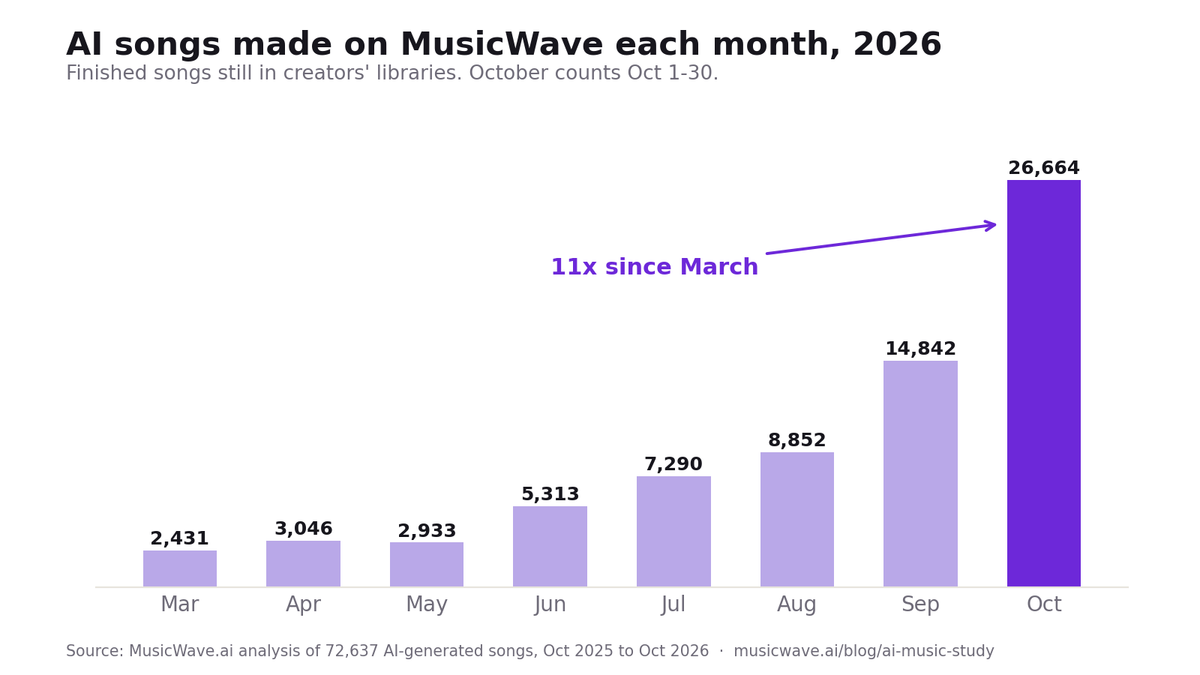
Our AI music study looks at what people make, in aggregate: 72,637 songs by 21,794 people on MusicWave between 12 October 2025 and 30 October 2026. It describes one platform's users, not all AI music.
- Themes: love leads at 14.8% of songs people described in their own words (45,813 songs), ahead of faith and worship at 8.1% and family at 7.2%.
- Personal songs: about 1 in 8 described songs (12.7%) is made for a specific person or occasion, such as a partner, family member, friend, birthday, wedding or memorial.
- Languages: 1 in 5 songs (20.6%) is prompted in a non-Latin script, led by Arabic at 12.3% and Cyrillic at 4.3%.
- Vocals: songs with vocals went from 65.5% of monthly output in March 2026 to 84.8% in October 2026.
- Growth: monthly songs grew about elevenfold, from 2,431 in March 2026 to 26,664 in October (1 to 30 October).
- Lyrics: 37% of October songs started from full lyrics, not a one-line description.
- Length: the average song runs 3 minutes 22 seconds, and 24.5% run past four minutes.
Songs for one person are a big use case, and it's what our personalized song gift is for. You share their name, a few memories and the occasion, and MusicWave writes and produces an original song you can send as a share link or an MP3.
If you'd like to start from words, like that 37%, our AI lyrics generator is free and gives you a draft to edit line by line.
How to cite this page
Please cite it as: MusicWave.ai, "AI Music Statistics 2026", checked 31 October 2026, https://www.musicwave.ai/blog/ai-music-statistics.
For third-party figures, credit the original source linked next to each number. MusicWave's own figures come from our AI music study and are free to use with a link.
For charts, high-resolution images or custom cuts of our data, email hello@musicwave.ai.
FAQ
What percentage of new music is AI-generated?
How many people use AI music generators?
How big is the AI music market?
The clearest hard number is Suno's $300 million in annual recurring revenue (February 2026), next to $31.7 billion for all recorded music in 2025 (IFPI). Forecasts from CISAC (€4 billion a year for AI music services by 2028) and Goldmedia (more than $3 billion by 2028) are estimates, not measurements. Treat any total without a named source as a guess.
Can people tell AI music from human-made music?
Mostly not by ear: 97% of the 9,000 people in Deezer and Ipsos's October 2025 study failed a blind test (Deezer/Ipsos). Software does better: Deezer says its detector is 99.8% accurate (Deezer).
Which record labels have deals with AI music companies?
Warner has deals with Suno, Udio, Stability AI and Klay, and Universal with Udio, Stability AI, Klay, ElevenLabs and Spotify's AI remix tool. Sony has licensed Klay and backs Spotify's AI plans, but it's still suing Suno and Udio, and Universal is still suing Suno as of October 2026 (The Next Web).